
About chariteadmin

This author has not yet filled in any details.
So far chariteadmin has created 16 blog entries.
14 10, 2026

An Autumn of Reflection and Connection

2026-10-14T09:52:12+02:00

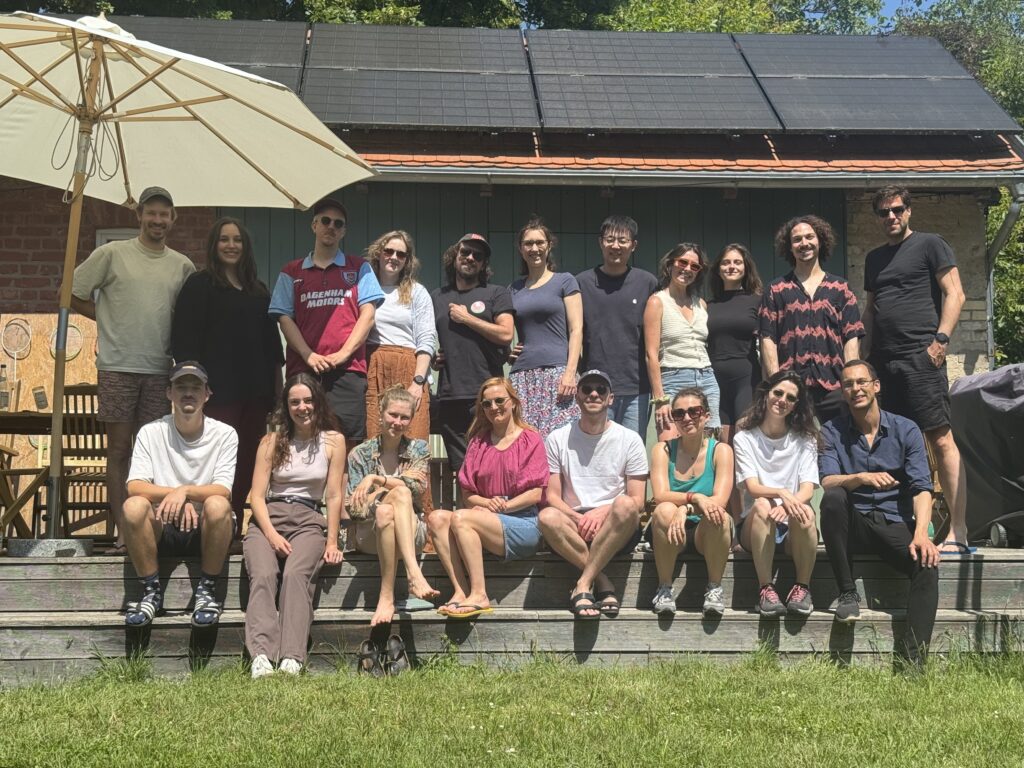
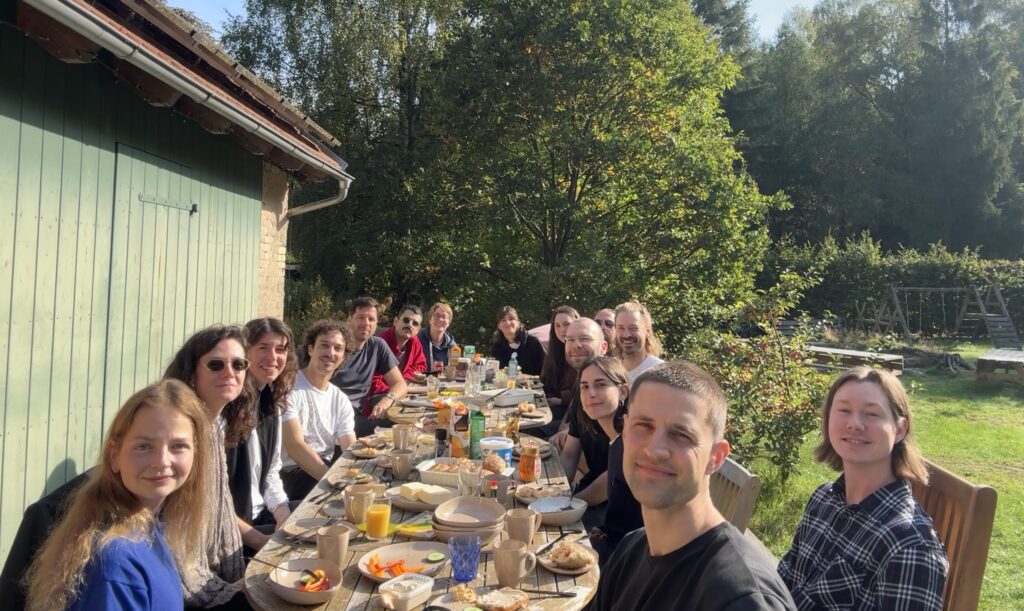
At the beginning of October, we had our annual lab retreat at Forsthaus Tornow. Under the colourful autumn leaves and by the campfire in the evening, we reflected on our plans for the lab and connected with the surroundings and each other.

For the first time, we also had an exciting night walk in the forest, hunting for clues and treasure as a team!
An Autumn of Reflection and Connection2026-10-14T09:52:12+02:00
28 09, 2026

New Study on Brain Development in Nature Neuroscience

2026-09-28T13:44:51+02:00


Our recent study “Fractal analysis of brain shape formation predicts age and genetic similarity in human newborns” has been published in Nature Neuroscience. 

Background: 

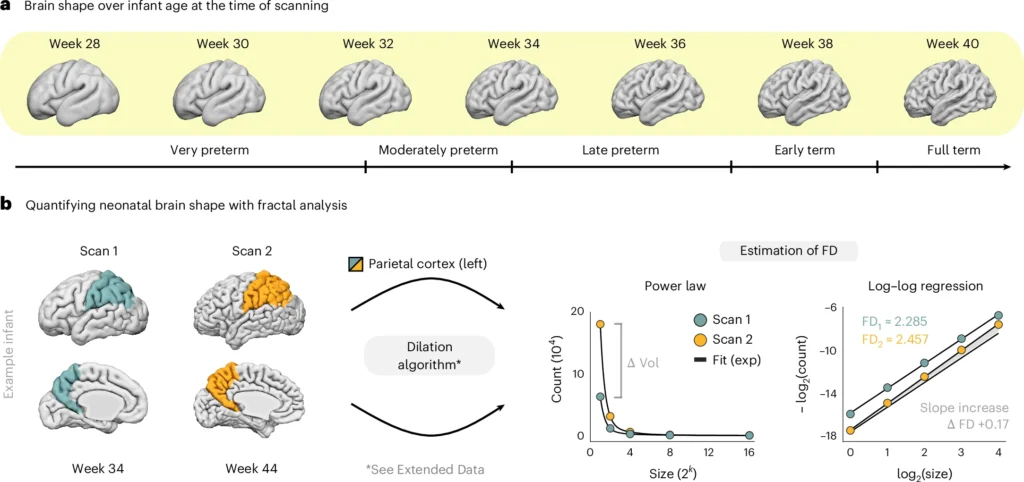
In this work, we studied how the human brain develops over the first few weeks after birth. While it is well known that the brains of newborn babies increase rapidly in size, here we studied how the brain develops its shape (see Fig. 1 below). 

To do this, we analyzed structural MRI data of nearly 800 human newborns from the developing Human Connectome Project (dHCP) and measured their brain shape with fractal dimensionality (FD) – a geometric measure of structural complexity.  

Key results:  

  • Brain shape reflects infant maturity better than brain size: FD was consistently better at capturing infant age compared to brain size (measured by volume). Not least, we were able to predict the age of the babies from their brain shapes with a mean error of ~4 days, significantly outperforming age prediction from brain size.  
  • Brain shape detects traces of premature birth that are not captured by brain size: Prematurely born infants showed persistent alterations of FD but not volume compared to term-born babies, even when they were scanned at the same age.  
  • Similarity in brain shape reflects similarity in genetic information: The brains of any two babies were more similar in shape if they shared more genetic information. Specifically, brain shapes were more similar in infants of the same sex, in biologically related compared to unrelated infants, and in identical twins (that share ~100% of their genes) compared to fraternal twins (that share ~50% of their genes).    
  • Brain shape analysis with FD systematically outperforms previous measures: Age and genetic information were captured systematically better by FD – not only compared to volume but also to other common brain measures, including cortical thickness, curvature, gyrification, sulcation, surface area, and the T1-weighted/T2-weighted ratio. 

Interpretation: 

The formation of brain shape represents a fundamental maturational process in human brain development – beyond growth in size. Brain shape analysis with FD captures biologically relevant information better than earlier neuroimaging measures, offering a powerful new framework to study both normative brain development and disease-related changes of brain morphology.

Like to know more? 

You can find the full paper here (open access).
The study was highlighted in a paper spotlight by the Charité press department (in English and in German) and was voted paper of the month at Charité Neurology.
If you’re interested, do reach out to us – we are always happy to discuss!


Fig. 1: Quantifying brain shape in human newborns. a, Differences in brain shape over infant age at the time of scanning, illustrated for cortical gray matter of the left hemisphere. Surface renderings correspond to the age-specific group averages of the developing Human Connectome Project (dHCP). Maturity levels follow the criteria by the World Health Organization (WHO) and the American College of Obstetricians & Gynecologists (ACOG). b, Quantifying neonatal brain shape with fractal dimensionality (FD). The FD estimate is calculated from a dilation procedure of the voxel-indexed segmentation mask, which measures the scaling properties of the structure through iterative convolution with varying spatial kernels (see Extended Data Fig. 1 for an illustration). Scaling behavior is assessed by the power law relationship between kernel size and the count of scaled measurement units after convolution. The slope of this relationship in log−log space then yields the structure’s FD estimate. This estimation is illustrated for the left parietal cortex of an exemplary infant born at 32.6 weeks and scanned at 34 weeks and 44 weeks post-menstrual age. Over this 10-week interval, the morphological change of the region (left) is reflected by an increase in the structural complexity estimate (right). exp, exponential; Vol, volume. 

New Study on Brain Development in Nature Neuroscience2026-09-28T13:44:51+02:00
1 09, 2025

A Summer of Running and Resting

2025-09-01T14:22:37+02:00


This summer we had the chance to celebrate the lab spirit in two different ways.

At the Charité Team-Staffellauf, our runners delivered a strong performance and finished in 8th place out of all mixed Charité teams. Not bad! More important than the result, though, was the great atmosphere and the friends we made along the way (on and off the track). Thanks to everyone who ran and everyone who came out to cheer!

A few weeks later we gathered for our yearly retreat at Forsthaus Tornow. Alongside discussions about ongoing and future projects, there was plenty of time to enjoy the surroundings — swimming in the lake, sitting by the fire, and long walks through the forest.

We’re already looking forward to repeating the running and the resting in 2026.


A Summer of Running and Resting2025-09-01T14:22:37+02:00
9 07, 2025

New publication in Computers in Human Behavior Reports: Psychometric data and regression-based norms for the virtual environments navigation assessment for young and middle-aged adults (VIENNA Young)

2025-07-09T14:08:30+02:00


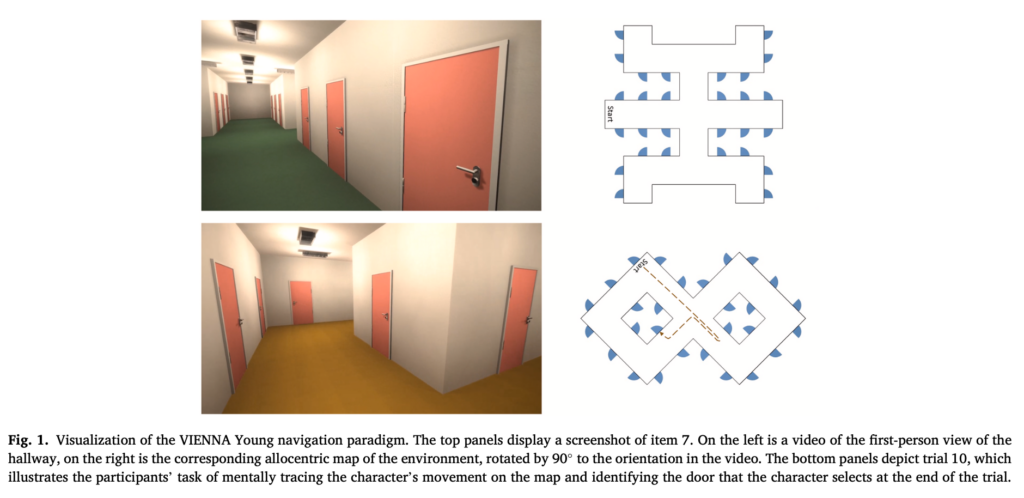
VIENNA Young is a 16-minute, passive virtual-environment paradigm expressly developed to examine visuospatial and executive aspects of spatial navigation while minimizing episodic-memory demands. The assessment runs locally (Python/PsychoPy) or remotely (web-based). In a hybrid onsite/online study of 422 healthy adults (18–67 years) VIENNA Young showed strong reliability and construct validity. We provide a flexible regression-based norming framework that lets users select the most appropriate reference cohort by adjusting for age, gender and video-gaming experience.
The study yields two substantive insights:
• Gaming phenotype: Even without controller interaction, gamers outperformed non-gamers, and the advantage was especially pronounced in regular players of allocentric (top-down) games, but not in egocentric gamers, indicating that beyond mere exposure, gaming style shapes spatial skill.
• Urban–rural dynamics: Unexpectedly, current city residents scored higher than rural residents, yet controlling for current residency, individuals raised in rural settings achieved higher VIENNA Young scores. This interaction hints at nuanced interplay of environmental and sociodemographic factors that merit further investigation.
By combining rigorous psychometrics, flexible administration options and fine-grained normative modelling, VIENNA Young provides researchers with an accessible and scalable tool for evaluating everyday spatial navigation performance in research in clinical settings.


Reference:
Rekers, S., Meyer, T. C., & Finke, C. (2025). Psychometric data and regression-based norms for the virtual environments navigation assessment for young and middle-aged adults (VIENNA Young). Computers in Human Behavior Reports, 19, 100730. https://doi.org/10.1016/j.chbr.2025.100730 [pdf]

New publication in Computers in Human Behavior Reports: Psychometric data and regression-based norms for the virtual environments navigation assessment for young and middle-aged adults (VIENNA Young)2025-07-09T14:08:30+02:00
15 08, 2024

New Article in Journal of Neurology presents German Psychometric and Normative Data for Multifactorial Memory Questionnaire (MMQ)

2024-08-15T17:20:10+02:00

Our paper on the German psychometric and normative data of the Multifactorial Memory Questionnaire (MMQ) is finally published in Journal of Neurology [link to paper] . It’s completely open access (paper, data, analyses) and the questionnaire freely available for researchers and clinicians at online and can be downloaded here:  [link to questionnaire]

Next to a comprehensive examination of the MMQ scales’ distribution, validity, and reliability in 336 participants with a follow-up after 8 months, we provide reliable change scores, normative data for both the validated 3-factor and 4-factor models, and practical recommendations for their application and interpretation.

Moreover, we show that memory satisfaction and self-rated ability are already decreased at subclinically elevated levels of anxiety, and depressiveness, and that neuropsychiatric factors have a differential impact on metamemory across the lifespan.

New Article in Journal of Neurology presents German Psychometric and Normative Data for Multifactorial Memory Questionnaire (MMQ)2024-08-15T17:20:10+02:00
12 05, 2023

We’re hiring! Postdoctoral position in the „PAN-Assistant” project: navigation training in post-acute neurorehabilitation

2023-05-12T16:14:25+02:00

Aufgaben:

  • Mitentwicklung des Taskdesigns für das Assistenzsystem
  • Konzeptuelle Mitarbeit am Interaktionsdesign für Mixed-Reality
  • Durchführung von iterativen Usability Untersuchungen mit gesunden Kontrollen und Patient:innen mit schweren kognitiven Einschränkungen
  • Projektadministration, Kommunikation und Zusammenarbeit mit den Studienzentren, Datenanalyse, Publikation der Daten

Erforderlich sind:

  • Abgeschlossenes Studium der Psychologie, Medizin, Kognitiven Neurowissenschaften oder in einem vergleichbaren Fach
  • PhD/Dissertation mit sehr gutem Abschluss im Bereich Neuropsychologie/ kognitive Neurowissenschaften
  • Erfahrungen in der Durchführung wissenschaftlicher Projekte
  • Erfahrungen im Umgang mit neurologischen Patient:innen mit kognitiven Einschränkungen
  • Erfahrungen mit neuropsychologischer Diagnostik und qualitativen Analysen
  • Erfahrungen in der Publikation von Forschungsergebnissen

Wünschenswert sind:

  • Erfahrungen in der Datenanalyse und -darstellung inkl. sehr gute statistischer Kenntnisse
  • Erfahrungen in der Entwicklung/ Erforschung von neuen Technologien für den klinischen/ wissenschaftlichen Einsatz (VR/ AR/ Wearables)
  • Erfahrungen im Forschungsbereich räumliche Kognition/ Navigation


We’re hiring! Postdoctoral position in the „PAN-Assistant” project: navigation training in post-acute neurorehabilitation2023-05-12T16:14:25+02:00
22 09, 2022

We’re hiring! Werkvertrag, Webdeveloper (m/w/d)

2022-09-22T17:19:05+02:00

Ausschreibung Werkvertrag, Webdeveloper (m/w/d)

We’re hiring! Werkvertrag, Webdeveloper (m/w/d)2022-09-22T17:19:05+02:00
7 06, 2022

We’re hiring! PhD position „Contextual modulation of spatial memory consolidation”

2022-06-07T14:03:16+02:00

We’re hiring! PhD „Contextual modulation of spatial memory consolidation” within the Collaborative Research Center 1315 “Memory Consolidation” (SFB 1315)

We’re hiring! PhD position „Contextual modulation of spatial memory consolidation”2022-06-07T14:03:16+02:00
25 05, 2022

We’re hiring! Postdoctoral Position „Contextual modulation of spatial memory consolidation”

2022-06-07T14:06:24+02:00

We’re hiring! Postdoctoral Position „Contextual modulation of spatial memory consolidation” within the Collaborative Research Center 1315 “Memory Consolidation” (SFB 1315)

We’re hiring! Postdoctoral Position „Contextual modulation of spatial memory consolidation”2022-06-07T14:06:24+02:00
27 05, 2022

New preprint – The virtual environments navigation assessment (VIENNA)

2022-05-27T13:00:14+02:00

New preprint – Translating spatial navigation evaluation from experimental to clinical settings – the virtual environments navigation assessment (VIENNA)

New preprint – The virtual environments navigation assessment (VIENNA)2022-05-27T13:00:14+02:00
Go to Top